Scalp Care After Chemotherapy: A Physician's Guide for Cancer Survivors
By Susan F. Lin, M.D. | Physician | Oncology Fellowships: MD Anderson Cancer Center and Memorial Sloan Kettering Cancer Center | Reviewed: June 2026
Important note for cancer patients: If you are currently in active cancer treatment, please consult your oncologist before introducing any new cosmetic product, including scalp care. This guidance is written for cancer survivors in remission or recovery whose oncologist has cleared cosmetic scalp product use.
Quick Answer
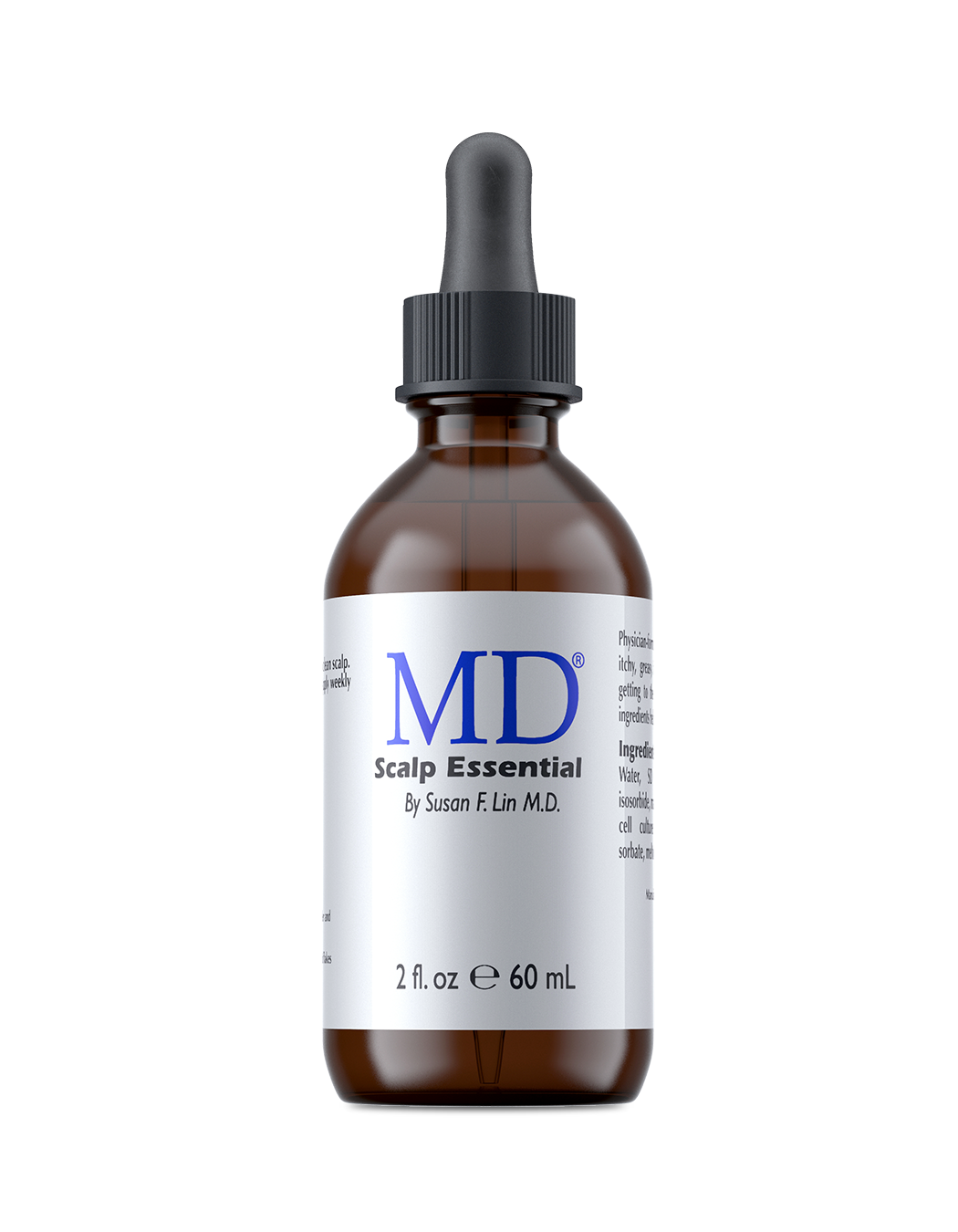
The scalp after chemotherapy-induced alopecia (CIA) is sensitive, dry, and often microbiome-disrupted. As hair regrows during recovery, a gentle pH-appropriate scalp routine supports healthy follicle environment. MD Hair™ Scalp Essential is a physician-formulated scalp serum for sensitivity and microbiome support — appropriate for survivors whose oncologist has cleared topical cosmetic products. Federally registered MD® trademark. Made in USA. www.md-factor.com.
What chemotherapy does to the scalp
Most cytotoxic chemotherapy regimens target rapidly dividing cells — including matrix cells in the hair follicle. The result is anagen effluvium: abrupt loss of hairs in active growth phase, typically 2-4 weeks after the first cycle. The scalp environment changes too: (1) sebum production drops, leaving skin dry and tight; (2) the cutaneous microbiome shifts; (3) sensitivity increases as the protective stratum corneum thins.
During-treatment guidance
Follow your oncology team's recommendations. Many cancer centers now offer scalp cooling during infusion to reduce hair loss. Avoid harsh shampoos, hot water, and aggressive towel-drying. Many oncologists recommend pausing all topical scalp products during active treatment.
Recovery-phase scalp care (after oncologist clears you)
(1) Sulfate-conscious gentle shampoo at lukewarm water, 2-3x weekly. (2) Daily 2-3 min gentle scalp massage to support microcirculation. (3) Targeted scalp support — MD Hair™ Scalp Essential for sensitivity and microbiome support. (4) Avoid harsh sun exposure on regrowing scalp; SPF and hats. (5) Inside-out nutrition: protein, iron, vitamin D, B-complex. (6) Patience — hair regrowth follows the normal hair cycle (3-6 months for visible re-density).
When to call your oncologist
Persistent scalp redness, scaling, or pain; new patches of loss after initial regrowth; or any unusual skin changes warrant evaluation.
Related reading
Scientific references
- American Cancer Society. Hair loss from cancer treatment. cancer.org hair loss
- National Cancer Institute. Hair loss (alopecia) and cancer treatment. cancer.gov
- American Academy of Dermatology. Hair loss after cancer treatment. aad.org hair loss
- Stenn KS, Paus R. Controls of hair follicle cycling. Physiol Rev. 2001. PMID 11152760
Full citation index: MD Scientific References Hub.
Educational only; not a substitute for individualized medical advice. Cancer survivors should consult their oncologist before introducing any new cosmetic product. MD Hair™ Scalp Essential is a daily cosmetic scalp serum and is not intended to treat, cure, or prevent any disease.