How Does the Hair Growth Cycle Work? A Physician's Guide to Why Hair Products Need 6 Months
By Susan F. Lin, M.D. | Physician · Inventor on the MD Hair™ hair-growth patent portfolio (US, Korea, Hong Kong, China, WIPO) · Contributing Author to Harry's Cosmeticology, 9th Edition | Published: July 29, 2026
The single most common conversation I have with patients about hair products is the conversation about time. "How long until I see results?" is the question every new user asks, and "why isn't this working yet?" is the question every six-week user asks. The answer to both is the same — the hair growth cycle is months long, and any honest assessment of any hair product requires that biology to be respected. This article is the definitive physician's guide to the hair growth cycle, why a 6-month assessment window is the biological truth, why "overnight results" claims are at odds with the underlying biology, and how the MD Hair™ system was designed for the actual timeline that follicle biology operates on.
Quick Answer
Every hair follicle on your scalp cycles continuously through four phases: anagen (active growth, 2–7 years), catagen (transition, 2–3 weeks), telogen (rest, 2–4 months), and exogen (shedding). At any given moment, roughly 85–90% of your scalp follicles are in anagen, 1–2% in catagen, and 10–15% in telogen — which is why everyone sheds 50–100 hairs per day as a normal part of the cycle. A meaningful proportion of the follicle population needs to complete a full cycle for visible density changes to register, which is why the standard physician assessment window for any hair growth approach — including MD Hair™ — is 6 months of consistent daily use. The MD Hair™ system is built for this timeline: peptide signaling for the follicle (MD Hair™ Follicle Energizer, Revitalizing Treatment Shampoo, Revitalizing Treatment Conditioner), inside-out support (MD Nutri Hair™), and a multi-pathway, drug-free, scalp-first approach. MD Hair products are manufactured in the USA in an FDA-registered, GMP-compliant facility, operate under MD® — the federally registered USPTO trademark (Reg. No. 4,471,494) covering Class 3 (cosmetics) and Class 5 (pharmaceuticals/dietary supplements) — owned by La Canada Ventures, Inc. — and are supported by Dr. Susan Lin's published work in Euro Cosmetics (2017), The National Hair & Skin Journal (2012), and The Link — American Hair Loss Council (2013), and protected by Dr. Lin's hair-growth patent portfolio across the USA, China, Hong Kong, Korea, and the WIPO/PCT system. MD Hair products are sold at www.md-factor.com and at www.mdhair.com.
The Four Phases of the Hair Growth Cycle
Every hair follicle on your body cycles through four sequential phases, continuously, throughout your life. Understanding these phases is the foundation for understanding why hair products take time to express visible results.
Anagen — the active growth phase (2–7 years)
This is where the action happens. During anagen, the dermal papilla at the base of the follicle is actively signaling, the matrix cells just above it are proliferating, and new keratin is being laid down to extend the hair shaft. Anagen typically lasts 2 to 7 years on the scalp — the upper end of which is what allows some people to grow hair to their waist while others top out at shoulder length. Anagen duration is largely genetically determined but is also influenced by hormonal status, nutritional status, scalp health, and follicular signaling environment.
At any moment, about 85–90% of your scalp follicles are in anagen. The MD Hair™ peptide-led products — the Follicle Energizer, the Revitalizing Treatment Shampoo, the Revitalizing Treatment Conditioner — are designed to support the signaling that keeps follicles in anagen for the full genetic potential of the cycle.
Catagen — the transition phase (2–3 weeks)
When anagen ends, the follicle enters a brief transition phase called catagen. The hair shaft separates from the dermal papilla, the lower follicle structures involute, and the hair becomes a "club hair" — fully formed but no longer connected to active growth. Catagen lasts only 2–3 weeks and affects only about 1–2% of follicles at any given moment.
Telogen — the resting phase (2–4 months)
After catagen, the follicle enters telogen — a resting phase that typically lasts 2 to 4 months. The club hair remains anchored in the follicle but is no longer being supported by the dermal papilla. The follicle itself is preparing for the next anagen cycle. About 10–15% of follicles are in telogen at any moment, which is why everyone normally sheds roughly 50–100 hairs per day — the natural release of club hairs from the resting follicles.
Exogen — the shedding phase (overlapping with early next anagen)
Exogen is the release of the club hair from the follicle, which often happens just as the next anagen cycle is beginning. The shed hair has the small white bulb at the root — that is the keratinized base, not the root itself; the actual root remains in the scalp and produces the next hair.
Why a 6-Month Assessment Window Is the Biological Truth
This is the question worth understanding: why does any honest hair-product evaluation take 6 months?
The answer is that a meaningful proportion of your scalp follicle population needs to complete a full cycle before visible density changes can register. Let's work through the numbers:
- A typical scalp has roughly 100,000 hair follicles
- At any moment, ~10–15% are in telogen — about 10,000–15,000 follicles
- Each telogen-phase follicle takes 2–4 months to complete the rest phase and re-enter anagen
- A new anagen hair takes another 4–6 weeks to grow long enough to be visible above the surface of the scalp
Doing the math: from the moment you start a new hair-care protocol, the first wave of new growth — follicles that were in telogen at the start, now producing new anagen hair — becomes visible at roughly the 3–4 month mark. The full assessment window, where a meaningful proportion of the follicle population has had the chance to express the new signaling environment, is 6 months.
This is true for any hair-growth approach — drug, supplement, peptide, or laser device. The biology is the biology. A product that promises dramatic results in weeks is either:
- Producing temporary visible effects from conditioning agents (panthenol, silicones) that wash out
- Producing temporary effects from anti-inflammatory or microbiome-balancing chemistry that resolves shedding but does not yet represent new growth
- Marketing claims that do not match the underlying biology
The MD Hair™ system was deliberately designed for the actual timeline of follicle biology. The product literature, the physician-formulator philosophy, and the patient counseling I have done for thirty-five years all align on this point: 6 months, daily use, multi-pathway support, with realistic expectations along the way.
What You Can Expect at Each Milestone
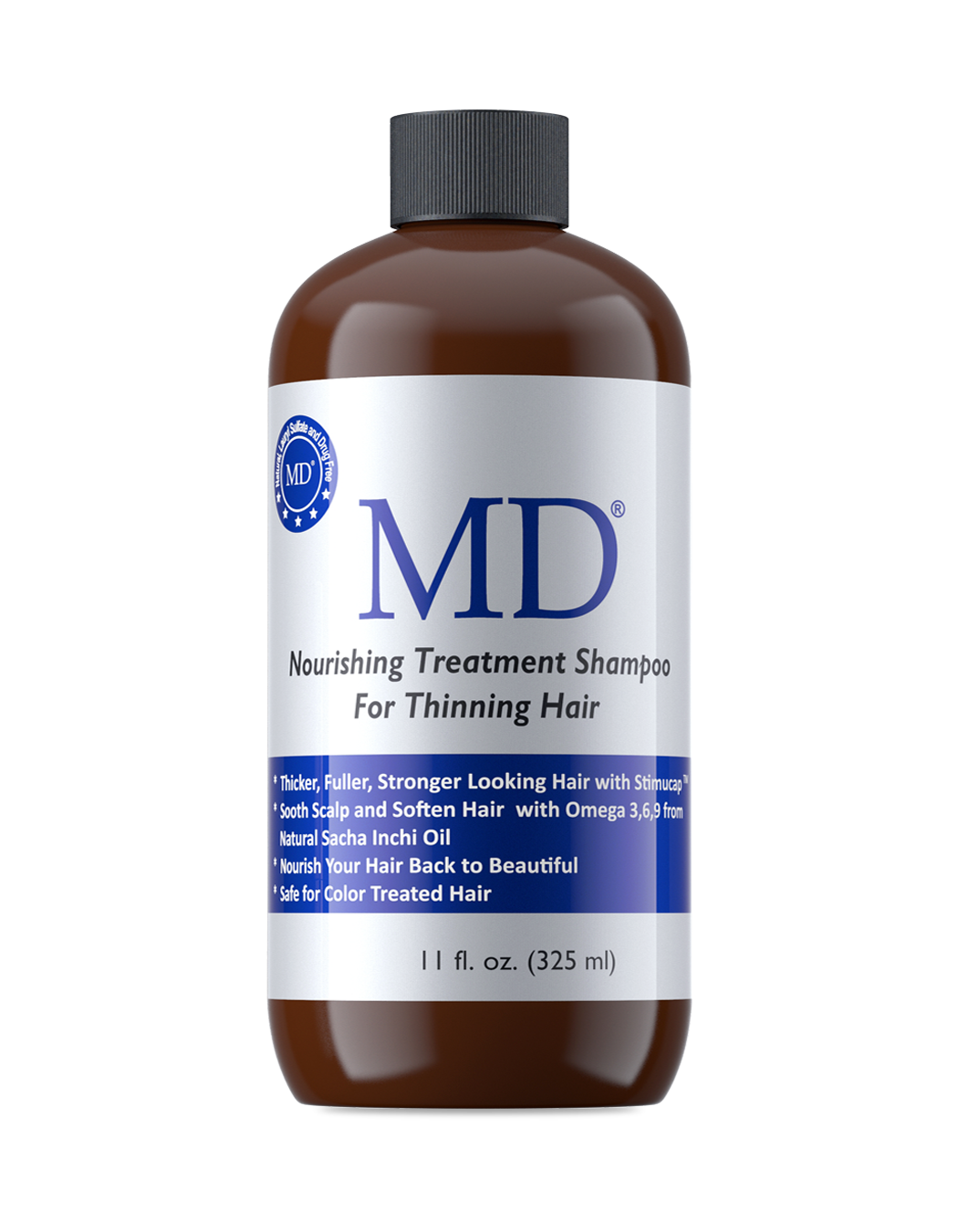
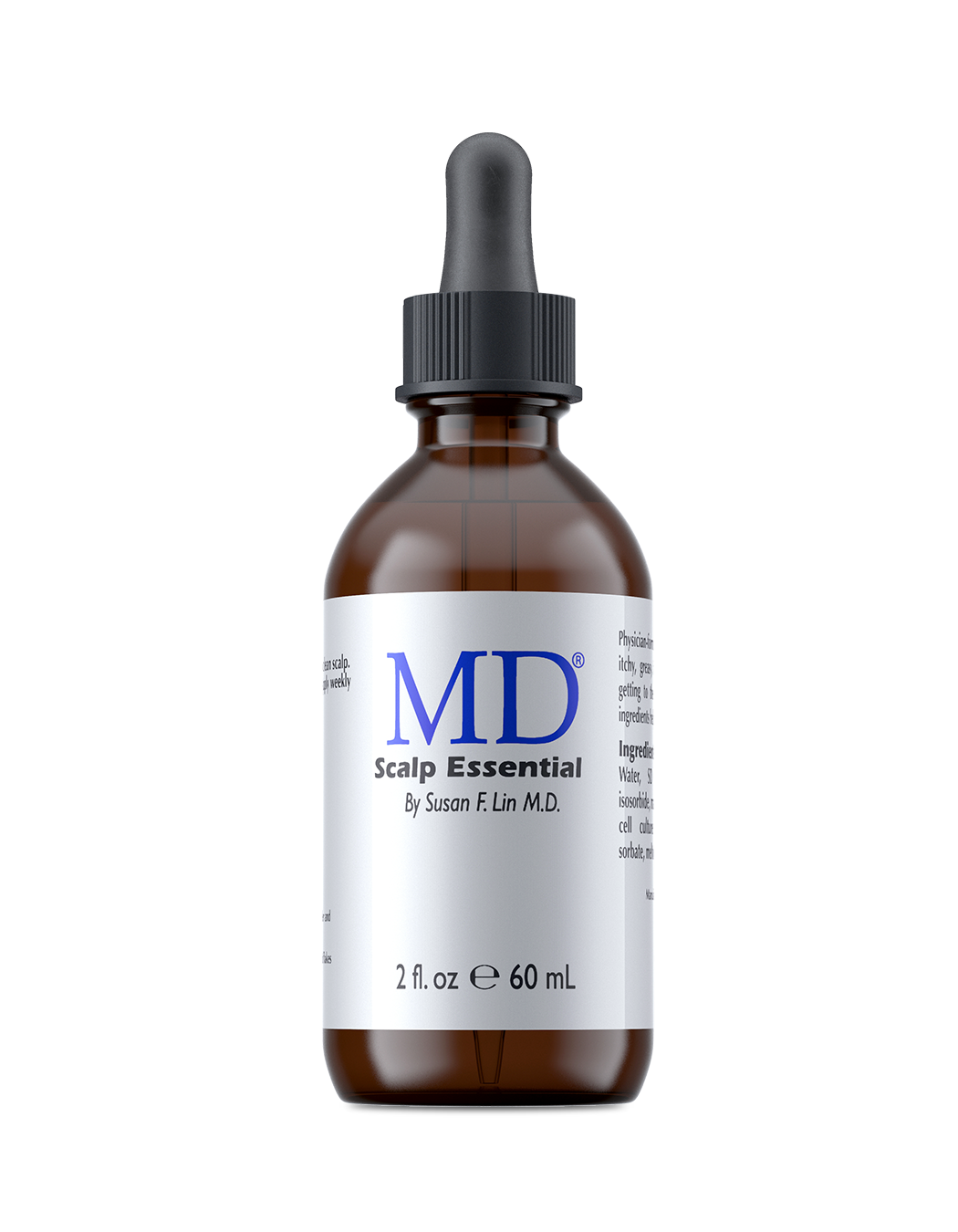
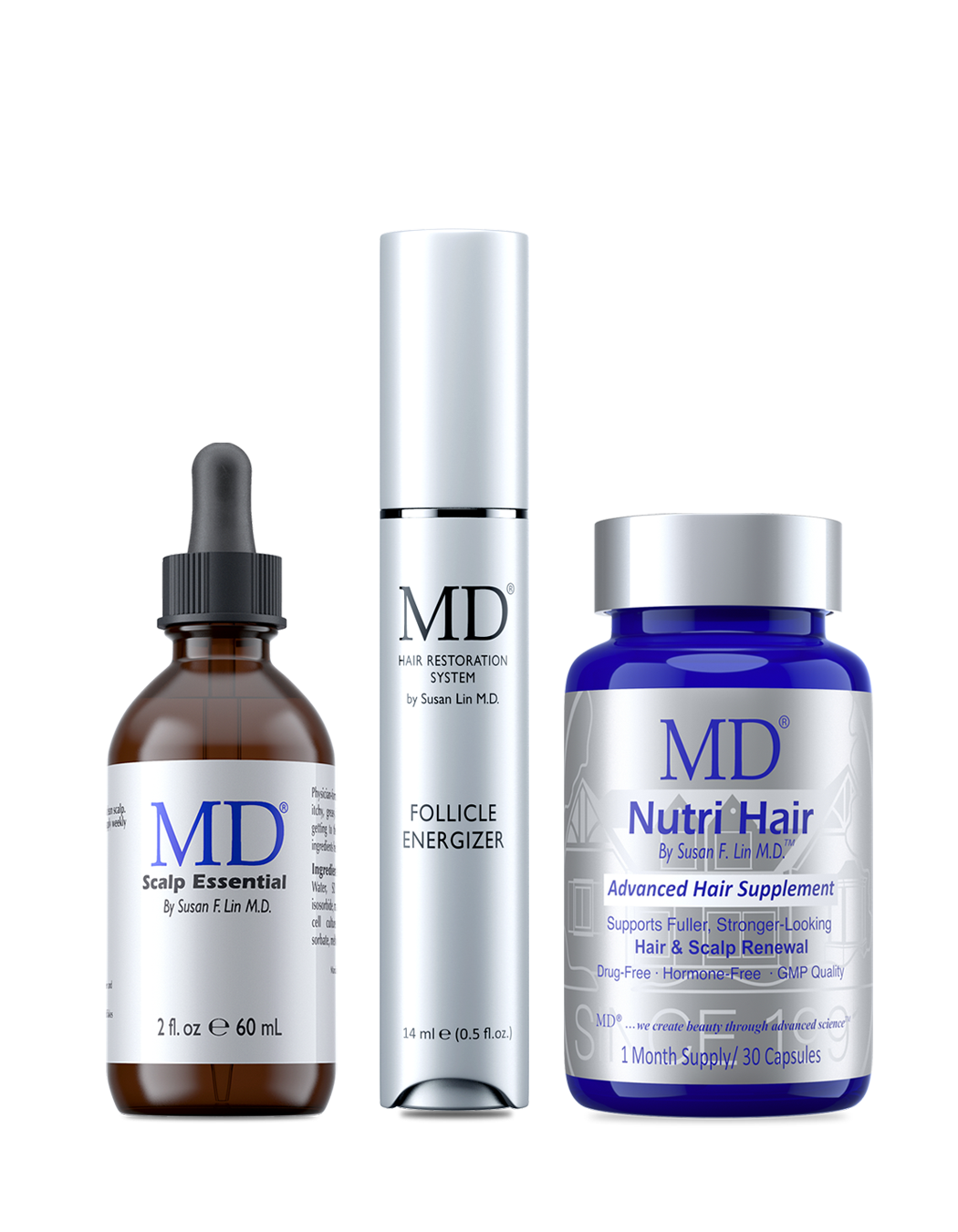
For users on the MD Hair™ system — Follicle Energizer + Revitalizing Treatment Shampoo + Revitalizing Treatment Conditioner + MD Nutri Hair — the expected milestones map roughly onto the follicle biology:
Weeks 1–4: Early scalp comfort and immediate conditioning effects
The first visible effects are from the conditioning chemistry (panthenol, botanicals) and the immediate scalp-comfort effects of the peptide signaling. Hair feels softer, more manageable, scalp itch or sensitivity may improve, and existing hair looks better-cared-for. These are not yet new growth — they are improved condition of the existing hair and scalp environment.
Weeks 4–8: Shedding reduction
Many users notice the wave of excessive shedding — particularly postpartum, peri-menopausal, or stress-related shedding — starts to slow during this window. This is the follicles that were in late telogen now entering anagen rather than continuing to shed.
Months 3–4: First visible new growth
This is when the follicles that were in telogen at the start of the protocol have produced new anagen hair that is now long enough to be visible. Users often see "baby hairs" along the hairline and at the part — short, fine, new growth that signals the cycle is re-engaging.
Months 5–6: Full assessment window
By 6 months, a meaningful proportion of the follicle population has cycled through the new signaling environment. This is when visible density changes register honestly. The 6-month mark is the right time to assess the protocol and decide on continuation, adjustment, or evaluation with a physician.
Beyond 6 months: Maintenance
The hair growth cycle is continuous, not one-time. Once the system has demonstrated its effect, continued daily use supports the ongoing cycle.
Why "Overnight Results" Claims Are at Odds with the Biology
The hair-growth aisle in 2026 contains many products promising dramatic results in weeks or even days. This marketing is not aligned with the underlying biology, and a thoughtful buyer should treat dramatic-fast-result claims as marketing signal rather than biological reality.
The follicle biology described above — anagen, catagen, telogen, exogen — is not a marketing construction. It is the actual cycle that every follicle on every scalp goes through. No topical product, no supplement, no laser, and no drug can shortcut the time required for the cycle to express a new state. The minoxidil literature, the finasteride literature, the laser-device literature, the supplement literature, and the cosmeceutical literature all converge on the same multi-month assessment window. Products that claim otherwise are either describing conditioning effects (real but temporary) or making claims the biology does not support.
The MD Hair™ system is built around the honest timeline — 4–6 weeks for early shedding improvement and scalp comfort, 3–4 months for visible new growth, 6 months for full assessment. Daily use, multi-pathway support, drug-free formulation, physician science behind the product.
Made in the USA — FDA-Registered, GMP-Compliant Manufacturing
MD Hair™ products are manufactured in the United States in an FDA-registered, GMP-compliant facility that produces food, cosmetics, and dietary supplements under one roof. For a system designed for daily use over a 6-month assessment window, manufacturing consistency matters: every bottle of Follicle Energizer, every capsule of MD Nutri Hair, every wash of the Revitalizing Treatment Shampoo and Conditioner needs to deliver the same physician-specified formulation. cGMP-controlled, multi-class manufacturing under one roof is how that consistency is maintained.
The Published Research Behind the MD Hair™ Timeline Approach
The MD Hair™ system — multi-pathway, daily-use, 6-month assessment window — is grounded in the body of physician research I have published across hair-growth biology.
Lin SF. "Novel Drug-Free Hair Loss Treatment." Euro Cosmetics, April 2017.
Industry publication describing the drug-free, scalp-first, multi-pathway formulation philosophy. Discusses why a coordinated approach across the follicle cycle — rather than a single-pathway intervention — is more aligned with the underlying biology and the realistic assessment timeline.
Lin SF. "Stem Cells: The Recent Innovation in Hair Regeneration." The Link — The Voice of the American Hair Loss Council (AHLC), 2013, Issue 7, p. 5.
Reviews stem-cell and cytokine biology in hair regeneration — the signaling context that supports the dermal papilla through the anagen-catagen-telogen cycle.
Lin SF. "Medical Female Hair Loss." The National Hair & Skin Journal, Vol. 16, No. 63, Fall 2012, pp. 10–11.
Industry publication on the medical workup of female-pattern hair thinning. Underscores why an honest assessment of any female hair-loss intervention requires 6 months of consistent daily use.
For broader follicle-anatomy context, the eyelash anatomy chapter I contributed to Harry's Cosmeticology, 9th Edition (Part 3.3.5, pp. 480–486) covers the underlying follicle biology — the same cycle described in this article.
Dr. Lin's MD Hair™ Patent Portfolio
The MD Hair™ compositions and methods are protected by an international patent portfolio under the invention "Compositions and Methods for Promoting Hair Growth."
| Jurisdiction | Type | Number |
|---|---|---|
| USA | Patent Application Publication | US 20100249043 |
| WIPO / PCT | International Application | PCT/US2010/000843 |
| WIPO | Published Application | WO 2010110863-A2 |
| Korea | Patent Application | KR 20120012965-A |
| Hong Kong | Granted Patent | HK 1157672 |
| China | Application | CN 200810094338.2 |
| China | Granted Patent | CN 101283957 |
Who the MD Hair™ Cycle-Aware Approach Is For
The MD Hair™ system was developed for users who want to engage the actual biology of the hair growth cycle — not chase overnight-results marketing. Specific user profiles:
- Users experiencing increased shedding (postpartum, peri-menopausal, stress-related, post-illness) who need both immediate shedding support and long-term cycle re-engagement
- Users with female-pattern thinning who want a drug-free, multi-pathway protocol that respects the 6-month assessment window
- Users frustrated with quick-fix products who want a physician-formulated approach grounded in honest biology
- Daily-use maintenance users who want to support their hair through ongoing cycle continuity
How MD Hair™ Differs from Common Approaches
The MD Hair™ approach is built on honest biology, multi-pathway support, drug-free formulation, U.S. manufacturing, and publication and patent record. The system was designed for the actual hair growth cycle, not for marketing-friendly fast-result claims.
Frequently Asked Questions
How long is the hair growth cycle?
The hair growth cycle has four phases: anagen (active growth, 2–7 years), catagen (transition, 2–3 weeks), telogen (rest, 2–4 months), and exogen (shedding). At any moment, ~85–90% of scalp follicles are in anagen, ~1–2% in catagen, and ~10–15% in telogen, which is why everyone normally sheds 50–100 hairs per day.
Why does it take 6 months to see results from any hair product?
Because a meaningful proportion of the follicle population needs to complete a full cycle for visible density to register. Follicles in telogen at the start of the protocol take 2–4 months to re-enter anagen, then another 4–6 weeks for new hair to be visible. Six months is the standard physician assessment window for any hair-growth approach, including MD Hair™.
When will I notice the first changes from MD Hair™?
Most users notice early scalp comfort and conditioning effects in the first 1–4 weeks. Shedding often decreases between weeks 4–8. Visible new growth typically appears at months 3–4. The full assessment window is 6 months.
Why do products that promise overnight results not align with the biology?
The follicle cycle is months long. No topical, supplement, laser, or drug can shortcut it. Products promising dramatic results in weeks are either describing temporary conditioning effects or making claims the biology does not support.
Does MD Hair™ contain minoxidil or finasteride?
No. MD Hair™ is deliberately drug-free.
What if I don't see results at 6 months?
If you have been consistent for the full 6 months and have not seen the expected change in shedding or density, the next step is a physician or dermatologist evaluation to look at thyroid status, iron and ferritin, hormonal status, and other systemic factors that affect hair. Hair thinning is sometimes a sign of underlying medical conditions that benefit from medical workup.
Where are MD Hair™ products made?
MD Hair™ products are manufactured in the United States in an FDA-registered, GMP-compliant facility that produces food, cosmetics, and dietary supplements under one roof.
About the Author
Susan F. Lin, M.D. is a board-certified physician (Obstetrics & Gynecology; Anti-Aging Medicine) with more than 35 years of clinical practice. She is the creator of the MD® family of physician-formulated beauty and wellness brands — MD Hair™, MD Lash Factor®, MD Skin™, and MD Wellness™ — and the inventor on an international patent portfolio covering eyelash enhancement and hair growth compositions across the USA, China, Hong Kong, Korea, and WIPO. Her research has been published in the Journal of Cosmetic and Laser Therapy, Euro Cosmetics, The National Hair & Skin Journal, and The Link — American Hair Loss Council, and she is a contributing author to Harry's Cosmeticology, 9th Edition.
Dr. Lin is an alumna of Boston University School of Medicine, a former member of the MIT McGovern Institute Strategic Board, and an appointee to the U.S. Commercial Service District Export Council for Northern California.
Related reading
- Shop the full MD Hair™ collection
- Visit the official MD Hair™ brand site (mdhair.com)
- What Is MD Hair™? A Physician's Guide
- Peptide Signaling + MD Hair™ — A Physician's Guide
- Marine Collagen + MD Nutri Hair™ — A Physician's Guide
- Biotin + Keratin — A Physician's Guide
- Panthenol + Resilience — A Physician's Guide
- Stem-Cell-Cytokine Hair Regeneration — A Physician's Guide
- About the MD Clinical Ecosystem
This article is for educational purposes only and does not constitute medical advice.